

Research Proposal
Academia Meets Real Life
While working on one of my master's courses (ETEC 500 - Research Methodologies in Education), I was blessed with the opportunity to base my final assignment on a real life project that I had recently undertaken while employed at Hanyang University in Seoul, South Korea.
The project involved redesigning and co-teaching a Basic Academic English (BAE) course. The final assignment was a research proposal that focused on the challenges and implications of converting in-person classroom courses into Blended Learning models. It proposed some specific research methodologies and included a sample Screening Questionnaire for faculty and students.
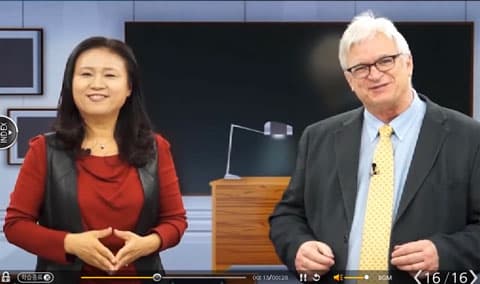
Screenshot: Basic Academic English - Online
Evolving Reflections
As often happens in life and learning, our views and opinions sometimes change as we acquire new knowledge. That is exactly what happened with my research proposal, as the two separate reflections (below) will illustrate:
Reflection #2 (July, 2015)
My Second Thoughts (after some new knowledge acquisition):
This second, more recent, reflection is entirely the result of new knowledge that I have acquired while working on the MET course ETEC 520: Planning and Managing Technologies in Higher Education. As a result of now being aware of the reality that universities are usually dominated by a collegial culture in which it is a "given" that faculty needs for autonomy and research pursuits are to be respected--and, at all costs, protected--I have found myself needing to do some serious rethinking about my earlier position while preparing the research proposal. In other words, I now realize that the course redesign project that is considered in the proposal has most likely evolved in the best way possible, given the fact that my university is, like most others, currently undergoing a period of change that is seriously challenging its collegial culture.
Among many other factors, a combination of cost cutting measures, technological advancements, and student demand for quality education, has prompted this change and the institutional leaders who manage the university's operation have recognized that a major shift towards Blended Learning (BL) could significantly lower costs in the long term. To design, redesign, and implement more BL courses requires the cooperation and collaboration of both managerial staff and instructional staff. However, managerial staff culture is very different from the faculty's collegial culture. In fact, according to higher education e-learning thought leaders [zotpressInText item="{TVNT5AIG},{KT72445J}"], they are often very much at odds with each other. Therefore, if the shift to BL courses is not handled with great care, such cooperation and collaboration between the two cultures may not be possible.
Now, in retrospect, I have a better understanding of why the decision makers for the proposal's redesign project took the minimally interactive approach to BL that they did. Had they directed the redesign team to make the online portion of the course fully interactive immediately in its first iteration, they would have been ignoring the concerns--and collegial culture--of many faculty and probably increased their resistance to the use of educational technology and the entire BL initiative. That is why, before submitting it to my university, I would need to seriously rethink and rework the entire proposal.
Because this ePortfolio is intended to document my learning and professional development, the first reflection that I originally composed several months ago, is posted below, inside the other toggle.
References
[zotpressInTextBib style="apa" sort="ASC"]
Reflection #1: Original Reflection
Please Note: The following reflection was written before I had a clearer understanding of how collegial and managerial cultures co-exist in higher education and my views have since changed considerably. It is posted here solely as a means of tracking my professional growth and, as stated in Reflection #2, I now believe that the entire research proposal needs to be redeveloped according to my new understanding of how higher education institutions function.
Reflection #1
This reflection is being posted more than 18 months after completing this assignment. It was not posted immediately because, when I took this course, I was less than half way through the UBC MET Program and had not yet completed enough scholarly work to feel confident about defending this paper, should it ever be necessary. However, now that I am literally just weeks away from receiving my Master's with a solid A+ average--and continuing to enjoy respect from my UBC peers and UBC professors--the time has come to go ahead and confidently publish this work, knowing that it is thoroughly researched and well supported.
The proposal is based on a real-life situation at my current place of employment--and it accurately describes a series of events that may cause some discomfort for the decision makers who were responsible for those events. But, more importantly, my research proposal also involves a much wider scope than just my immediate workplace and deals with an almost universal dilemma in higher education: how to implement instructional design changes that are pedagogically beneficial to students without being excessively problematic for effective and dedicated instructors. Please note that, although the proposal itself was very highly regarded by my UBC professor and UBC cohort collaborators, it was, for reasons that will be articulated in a future reflection, not possible to implement it at my current workplace. Regardless of that, I present my ideas here and now because they have relevancy and value that should be considered as we search for viable solutions to some increasingly complicated and challenging issues in higher education.
The paper is attached to the word cloud (which is based on the proposal). It is also embedded in a toggle (below) for devices that do not have Adobe Reader installed.
Tap or click to read the detailed assignment description and expectations
Research Proposal 35%
Developing a Research Proposal involves an iterative process of identifying a research problem, finding and selecting relevant and high-quality literature to gain an understanding of the scope and current thinking in a field of research, determining the best methods to apply to the research problem and planning the details of how to proceed with conducting a study. The process is not linear, but there are significant points within the process where decisions must be made upon the best information available to the researcher. In this assignment, you will engage in this iterative process, being cognizant of the opportunity to always review, revisit and refine your Research Problem in light of gaining insights along the way.
You will begin with an initial research problem or small set of research questions that will guide you to seek and select relevant literature to critically review. After you review the literature (a minimum of 8, a maximum of 10 high quality articles), you will select appropriate methods to apply to the research problem, and develop a plan that has as much detail as possible to carry out your study. You must articulate the rationale for your decisions and demonstrate that you have considered the most recent and best knowledge available to you. The following format will guide your work.
We strongly suggest that you begin thinking about your research problem during the first week of class. We will provide discussion forums for you to exchange and discuss your proposed topic and preliminary research questions with your colleagues for feedback. In Week 6, you will submit your provisional topic and a set of 3-5 research questions to the Assignment Dropbox for instructor approval (5%) so that you may proceed to the writing of the Research Proposal. This assignment should be no more than 1 page in length.
We strongly suggest that you also keep a personal log of your ideas as you proceed, these will be very valuable to you as insights continue to emerge in your thinking about this proposal.
Include all cited articles in APA formatting (Minimum of 8 and Maximum of 10). The total length should be no more than 4000 words excluding references.
SOURCE: ETEC 500 Syllabus - 2014
Tap or click here to check out the references for the above artifact.
References
[zotpress collection = "UW77NVB2" sortby="author" order="asc"]